Question thread #148

Feb. 9th, 2026 08:59 pm
pauamma: Cartooney crab wearing hot pink and acid green facemask holding drink with straw (Default)
[personal profile] pauamma posting in [site community profile] dw_dev
It's time for another question thread!

The rules:

- You may ask any dev-related question you have in a comment. (It doesn't even need to be about Dreamwidth, although if it involves a language/library/framework/database Dreamwidth doesn't use, you will probably get answers pointing that out and suggesting a better place to ask.)
- You may also answer any question, using the guidelines given in To Answer, Or Not To Answer and in this comment thread.
profiterole_reads: (Naruto Shippuuden - Sasuke and Naruto)
[personal profile] profiterole_reads
An Offer Fae Can't Refuse by Lou Wilham was a lot of fun! Sage is back from the dead and back in town. Mal now runs the Faceless Few fae mafia, but Sage is more interested in him than in his former seat at the Court of Families.

This is the first book of Fae of Eventide, set in the same world as Witches of Moondale and Hunters of Ironport (minor mentions so far, but I assume the crossovers will increase in time). If you want to follow the whole story (you don't need to, but you want to), Lou has provided the Reading Order in a practical format.

There is major m/nb, as well as f/f involving a trans woman.

Volunteer social thread #161

Feb. 9th, 2026 08:54 pm
pauamma: Cartooney crab wearing hot pink and acid green facemask holding drink with straw (Default)
[personal profile] pauamma posting in [site community profile] dw_volunteers
Ramadhan starts in about 1 week for me.

How's everyone doing?

Music Monday

Feb. 9th, 2026 08:10 am
potentiality_26: (Default)
[personal profile] potentiality_26
Been listening to this one a lot lately. 


Sidetracks - February 9, 2026

Feb. 9th, 2026 07:30 pm
helloladies: Gray icon with a horseshoe open side facing down with pink text underneath that says Sidetracks (sidetracks)
[personal profile] helloladies posting in [community profile] ladybusiness
Sidetracks is a collaborative project featuring various essays, videos, reviews, or other Internet content that we want to share. All past and current links for the Sidetracks project can be found in our Sidetracks tag. You can also support Sidetracks and our other work on Patreon.


Read more... )
ffutures: (Default)
[personal profile] ffutures
This is a bundle of two-player RPGs for Valentine's day, the fourth such offer from Bundle of Holding. They come from a variety of authors and publishers, genres range from Georgian romance to far future exploration and horror

 https://bundleofholding.com/presents/ForTwo4


This isn't really my preferred style of play - I prefer a larger pool of players - but if you like a more intimate approach to gaming the bundle is pretty cheap and may be worth a look. My personal favourite from these is probably Retired: The Ordinary Life of a Former Supervillain, which looks like it could be a lot of fun, and might be expanded to a larger group of characters, but several others look entertaining.

I was listening to an audiodrama

Feb. 9th, 2026 10:47 am
conuly: (Default)
[personal profile] conuly
(Mission Rejected, if you're curious)

and they took the time at the start of the most recent episode to talk about a charity in Minnesota that will bring food safely to people. I don't have the name of the charity, it's not on their website right now.

But what really struck me is that they spent a few minutes on this and never once mentioned or even alluded to why some people might need food to be delivered safely.

I'm not sure what I think about that, but I'm sure I don't like it much.

******************************


Read more... )
[syndicated profile] eff_feed

Posted by Aaron Mackey

For thirty years, internet users have benefited from a key federal law that allows everyone to express themselves, find community, organize politically, and participate in society. Section 230, which protects internet users’ speech by protecting the online intermediaries we rely on, is the legal support that sustains the internet as we know it.

Yet as Section 230 turns 30 this week, there are bipartisan proposals in Congress to either repeal or sunset the law. These proposals seize upon legitimate concerns with the harmful and anti-competitive practices of the largest tech companies, but then misdirect that anger toward Section 230.

But rolling back or eliminating Section 230 will not stop invasive corporate surveillance that harms all internet users. Killing Section 230 won’t end to the dominance of the current handful of large tech companies—it would cement their monopoly power

The current proposals also ignore a crucial question: what legal standard should replace Section 230? The bills provide no answer, refusing to grapple with the tradeoffs inherent in making online intermediaries liable for users’ speech.

This glaring omission shows what these proposals really are: grievances masquerading as legislation, not serious policy. Especially when the speech problems with alternatives to Section 230’s immunity are readily apparent, both in the U.S. and around the world. Experience shows that those systems result in more censorship of internet users’ lawful speech.

Let’s be clear: EFF defends Section 230 because it is the best available system to protect users’ speech online. By immunizing intermediaries for their users’ speech, Section 230 benefits users. Services can distribute our speech without filters, pre-clearance, or the threat of dubious takedown requests. Section 230 also directly protects internet users when they distribute other people’s speech online, such as when they reshare another users’ post or host a comment section on their blog.

It was the danger of losing the internet as a forum for diverse political discourse and culture that led to the law in 1996. Congress created Section 230’s limited civil immunity  because it recognized that promoting more user speech outweighed potential harms. Congress decided that when harmful speech occurs, it’s the speaker that should be held responsible—not the service that hosts the speech. The law also protects social platforms when they remove posts that are obscene or violate the services’ own standards. And Section 230 has limits: it does not immunize services if they violate federal criminal laws.

Section 230 Alternatives Would Protect Less Speech

With so much debate around the downsides of Section 230, it’s worth considering: What are some of the alternatives to immunity, and how would they shape the internet?

The least protective legal regime for online speech would be strict liability. Here, intermediaries always would be liable for their users’ speech—regardless of whether they contributed to the harm, or even knew about the harmful speech. It would likely end the widespread availability and openness of social media and web hosting services we’re used to. Instead, services would not let users speak without vetting the content first, via upload filters or other means. Small intermediaries with niche communities may simply disappear under the weight of such heavy liability.

Another alternative: Imposing legal duties on intermediaries, such as requiring that they act “reasonably” to limit harmful user content. This would likely result in platforms monitoring users’ speech before distributing it, and being extremely cautious about what they allow users to say. That inevitably would lead to the removal of lawful speech—probably on a large scale. Intermediaries would not be willing to defend their users’ speech in court, even it is entirely lawful. In a world where any service could be easily sued over user speech, only the biggest services will survive. They’re the ones that would have the legal and technical resources to weather the flood of lawsuits.

Another option is a notice-and-takedown regime, like what exists under the Digital Millennium Copyright Act. That will also result in takedowns of legitimate speech. And there’s no doubt such a system will be abused. EFF has documented how the DMCA leads to widespread removal  https://www.eff.org/takedownsof lawful speech based on frivolous copyright infringement claims. Replacing Section 230 with a takedown system will invite similar behavior, and powerful figures and government officials will use it to silence their critics.

The closest alternative to Section 230’s immunity provides protections from liability until an impartial court has issued a full and final ruling that user-generated content is illegal, and ordered that it be removed. These systems ensure that intermediaries will not have to cave to frivolous claims. But they still leave open the potential for censorship because intermediaries are unlikely to fight every lawsuit that seeks to remove lawful speech. The cost of vindicating lawful speech in court may be too high for intermediaries to handle at scale.

By contrast, immunity takes the variable of whether an intermediary will stand up for their users’ speech out of the equation. That is why Section 230 maximizes the ability for users to speak online.

In some narrow situations, Section 230 may leave victims without a legal remedy. Proposals aimed at those gaps should be considered, though lawmakers should pay careful attention that in vindicating victims, they do not broadly censor users’ speech. But those legitimate concerns are not the criticisms that Congress is levying against Section 230.

EFF will continue to fight for Section 230, as it remains the best available system to protect everyone’s ability to speak online.

For Art! and Science!

Feb. 9th, 2026 01:53 pm
rolanni: (Default)
[personal profile] rolanni

I . . . have been remiss in updating the blog, for which my apologies.  The last couple days have been not much worth writing about anyway -- mostly reading and doing daily chores, with intermittent sadness.

That said, we move on to!

Monday midday already. Sunny and cold. I put paper plates of seeds out on top the snow on the deck. I prolly shouldn't have done, but I miss seeing the birds. The cats are fascinated and the new sliders in Steve's office gets them right up close and personal.

I called Dead River this morning, while I was still sitting under the glow of the Happy Lite, and was therefore taught the new method of oil delivery. Back in the Old Days, the oil truck came on -- oh, Tuesday. Or possibly every other Tuesday. But, they delivered to a schedule, which they could be expected to keep, to top off the tank. This was ... simple. We have now graduated to a more complex system, wherein oil usage for a particular address is calculated, using known data, and when the oil tank at that particular address reaches what ought to be one/third full, an oil delivery is triggered.

I pause here to mourn simplicity.

The helpful office person I spoke with at the crack of dawn this morning explained this to me, though she could not tell me when the delivery would be triggered. We left it that a truck would come by sometime this week to top off my tank, and then I will Observe the System in Real Time, so that I may see for myself how well it works.

Moving on. Yesterday, my back hurt, and my hands hurt, and -- let's just say that I was a hurtin' person, enough that I was aware that I was hurting. After I finished my work with the WIP, and had written a draft of my Remarks, I decided to field test a gummy. For Science!

I cut a gummy in half (taking it from 10mg of THC to the 5mg  recommended for newbies), which dose is said to make one feel calm and subtly relaxed. It made me feel that I had drunk way too much wine.  Not a pleasant buzz, but rather a "shouldn't have had that last glass" light-headed-and-unsteady feeling. I mention here that the muscle relaxants and prescribed pain relievers also make me lightheaded and foolish on my feet.

On the plus side, I was feeling no pain. I spent the next while drinking lots of water, and eating snacks and listening to my audiobook, and eventually the "too much" feeling went away, and pretty soon thereafter, I went to bed, and slept very well.

And when I got up this morning, I was still pain-free.

So! Conclusions. Do gummies work for pain relief? Yessir, they do, and they don't make me sick. Most of the prescribed pain relievers and muscle relaxants really make me sick. Already, I'm ahead of the game. Do gummies work as a muscle relaxant? Seems so, since the pain hasn't come back today. And let's not discount that lovely night's sleep.

Obviously, I'm going to have to be very cautious with them, and I may want to conduct a follow-up experiment with one-quarter of a gummy, to see if I can get relief and! still be able to function.

But that's for later.

For today, I spent the morning reviewing the WIP and have less than 50 pages left to read. I'll be doing that after lunch, which will be bean and veggie soup out of the freezer. Unless I decide on something else.

Tomorrow, I will start the day off by opening the tax portal and will hopefully finish filling in the necessary forms before it's time to go to needlework.

Wednesday morning, first thing, Tali has an appointment with her vet, and when I come home I will begin reviewing beta reader comments, and starting the process of producing a final draft of the WIP.

Doesn't that look tidy and fine?

So! Who else is tidy and fine today?

Ah.  One of the things I let get past me was the Celebration of Talizea's Gotcha Day, on February 3.  Here, we have Then:

And now:


This seems bad.

Feb. 9th, 2026 10:50 am
muccamukk: Martha looking exasperated. Text: "sigh". (DW: -sighs-)
[personal profile] muccamukk
Discord will require a face scan or ID for full access next month | The Verge
Beginning in March, all accounts will have a ‘teen-appropriate experience by default.’
A government ID might still be required for age verification in its global rollout. According to Discord, to remove the new “teen-by-default” changes and limitations, “users can choose to use facial age estimation or submit a form of identification to [Discord’s] vendor partners, with more options coming in the future.”

(no subject)

Feb. 9th, 2026 01:43 pm
unicornduke: (Default)
[personal profile] unicornduke
 Hey all, if you'd like to join the crafting hangout, it is tonight from 6-8pm ET!
 
Video encouraged but not required!
 
Topic: Crafting Hangout
Time: Mondays 6:00 PM Eastern Time (US and Canada)
 
Join Zoom Meeting
 
Meeting ID: 973 2674 2763

commentary: like synapses

Feb. 9th, 2026 10:24 am
headstone: ((uc) char)
[personal profile] headstone

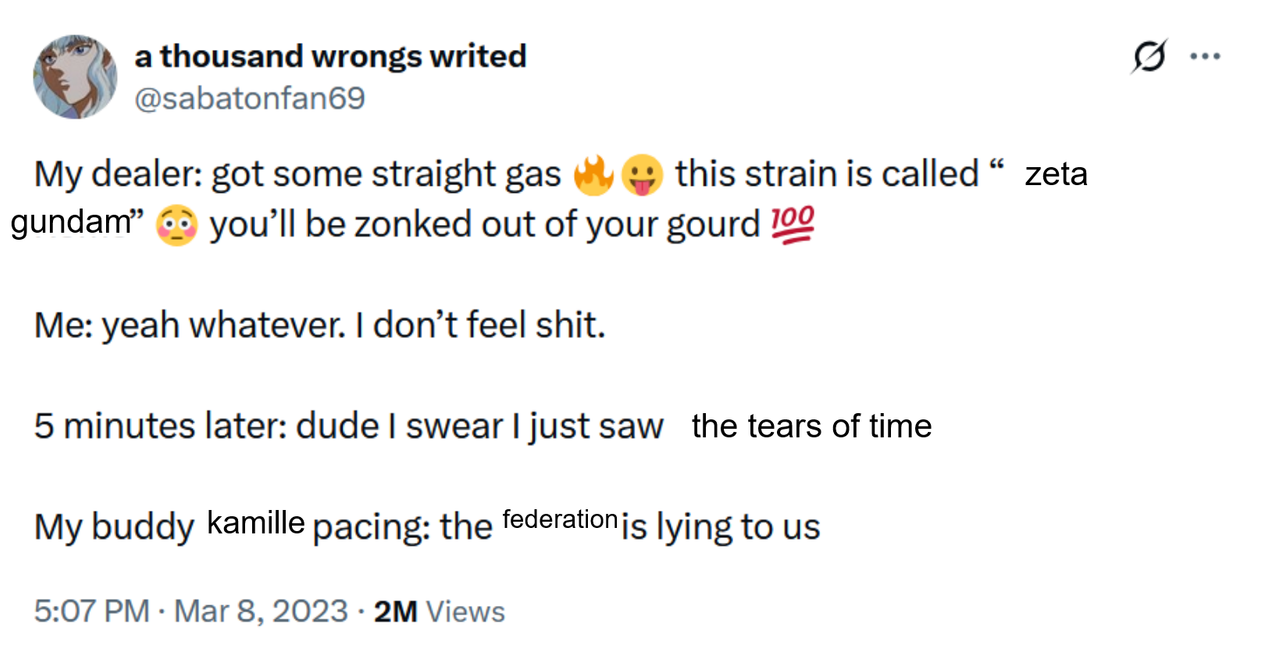
like synapses: my Haman Karn character study via forensic autopsy of what went on between Char and Haman before we’re introduced to their relationship in Zeta Gundam. This post, like the fic, contains spoilers for that show.

edited twitter screenshot containing the phrase "dude I swear I just saw the tears of time"

(post credit)

I'M A LITTLE GIRL / BOILED INTO A MATURE / LITTLE PIECE OF WORK )

annathecrow: screenshot from Star Wars: The Phantom Menace. A detail of the racing pod engines. (Default)
[personal profile] annathecrow posting in [community profile] dreamwars

Hi,

welcome to the weekly chat corner.

If you're into exchanges (and aren't already following the comm), the May the Fourth Exchange nominations are now open.

Are you into exchanges? Some people aren't so I'm curious. What do you think of the tradition, whether you are or not?

(Not specifically SW, I know. Feel free to talk about anything else of course, as usual.)

[syndicated profile] smartbitches_feed

Posted by Amanda

Dial A for Aunties

Dial A for Aunties by Jessie Q. Sutanto is $2.99! This is a mix of cozy mystery and romance. It’s also been recommended a ton of previous podcast episodes. Have you read it?

A hilariously quirky novel that is equal parts murder mystery, rom-com, and a celebration of mothers and daughters as well as a deep dive into Chinese-Indonesian culture, by debut author Jesse Q Sutanto.

1 (accidental) murder
2 thousand wedding guests
3 (maybe) cursed generations
4 meddling Asian aunties to the rescue!

When Meddelin Chan ends up accidentally killing her blind date, her meddlesome mother calls for her even more meddlesome aunties to help get rid of the body. Unfortunately, a dead body proves to be a lot more challenging to dispose of than one might anticipate, especially when it is accidentally shipped in a cake cooler to the over-the-top billionaire wedding Meddy, her Ma, and aunties are working, at an island resort on the California coastline. It’s the biggest job yet for their family wedding business—“Don’t leave your big day to chance, leave it to the Chans!”—and nothing, not even an unsavory corpse, will get in the way of her auntie’s perfect buttercream cake flowers.

But things go from inconvenient to downright torturous when Meddy’s great college love—and biggest heartbreak—makes a surprise appearance amid the wedding chaos. Is it possible to escape murder charges, charm her ex back into her life, and pull off a stunning wedding all in one weekend?

Add to Goodreads To-Read List →

You can find ordering info for this book here.


Overruled

Overruled by Lana Ferguson $1.99! This is a standalone romance with elements of enemies to lovers, a workplace setting, and a no strings attached arrangement.

Two divorce lawyers determined to share only beds but not hearts discover that love is something that can’t be overruled in this steamy contemporary romance.

Danica Pierce has one great love in her life: work. As one of the top divorce lawyers in Austin, Danica lets her caseload keep her warm at night and has no problem being married to her job, not when love only ends in hurt. When the biggest case of her career gives her a shot at making partner, it seems like nothing could possibly stand in her way…except for her infuriating secret: she’s sleeping with the enemy.

Ezra Hart is known for charming his way in and out of a courtroom. In the matter of winning Danica Pierce’s heart, however, he’s been far less successful. With her verdict to keep things purely physical with no chance of appeal, Ezra struggles to show Danica he’s more than the insufferable playboy she’s pegged him to be—especially since they find themselves on opposing sides of Danica’s most important case to date.

While Dani and Ezra battle it out in the courtroom, the real trial is the one happening between them. When Dani realizes that everything she knows of Ezra might be hearsay—and that she’s not the only one with emotional baggage—she must choose between her fear of trusting again and the feelings blossoming between her and the man she thought was her worst enemy.

Add to Goodreads To-Read List →

You can find ordering info for this book here.


The Musician and the Monster

The Musician and the Monster by Megan Van Dyke is $2.49 at Amazon! This is the first book in a duology but also the fourth book in the Reimagined Fairy Tales series. It’s a Gothic Gaslamp fantasy romance with elements of Beauty and the Beast and Phantom of the Opera.

Music says things words never can. I love you. I miss you. I’m sorry I killed you.

Every night, Ceridwen Kinsley plays music on her rooftop for the spirit of her dead mother. A peaceful if odd ritual, until she witnesses a murder by something not quite human. The monstrous encounter earns her notoriety within the city and a visit from the reclusive Lord Protector Drystan Winterbourne.

Charged with protecting the backwater city of Teneboure by the king, Drystan is failing at his task, and he can’t afford another slip up. But when fate and the very monster he means to conquer bring Ceridwen to his notice, he seizes the opportunity and presents her with an offer: play music for him at his manor in exchange for the money her impoverished family desperately needs. Music eases the strain of his magic, and who better to hire than the woman whose tunes he secretly listens to at night?

At first, Ceridwen is put off by Drystan’s unkempt appearance and harsh demeanor, not to mention the odd ailment that plagues him. But as he embraces her passion for music and she draws the recluse out of his lonely tower, the two develop an unlikely attachment. Class lines begin to blur as fearful indifference shifts to unexpected desire, and Ceridwen yearns to help Drystan subdue the monster as well as provide for her family. However, the monster prowling the night isn’t their only enemy, and as terrible secrets come to light, protecting those they love may risk their lives and their hearts.

This retelling of Beauty and the Beast incorporates themes and motifs from Phantom of the Opera, and is set in a gaslamp fantasy world with strong gothic vibes. It should appeal to fans of romantic and atmospheric retellings and fairy tales by authors such as Hannah Whitten, Tessonja Odette, and Stephanie Garber.

While this is book 4 in the Reimagined Fairy Tales series, it can be read as a standalone.

Add to Goodreads To-Read List →

You can find ordering info for this book here.


Last Light

Last Light by Claire Kent is $2.49 on Amazon! This a post-apocalyptic, road trip romance, and it’s been recommend previously in a couple Rec Leagues on post-apocalyptic romances.

It only took four years for the world to fall apart.

Now the last member of my family has died, and I’m forced to travel across what’s left of three states to find the only people I know left alive. To survive, I’ll have to salvage food and supplies and try to avoid violent men who’ve learned they can take what they want by force. The only way I’m going to make it is by trusting Travis.

Travis used to fix my car, and now he’s all I have left in the world. He’s gruff and stoic and unfriendly, and I don’t really know or like him. But he’s all I have left. He’ll keep me safe. We’ll take care of each other. Until we reach what’s left of our town and can finally let go of one another.

Last Light is a standalone post-apocalyptic romance set in the near future after a global catastrophe.

Add to Goodreads To-Read List →

You can find ordering info for this book here.


[syndicated profile] eff_feed

Posted by David Greene

(This appeared as an op-ed published Friday, Feb. 6 in the Daily Journal, a California legal newspaper.)

Section 230, “the 26 words that created the internet,” was enacted 30 years ago this week. It was no rush-job—rather, it was the result of wise legislative deliberation and foresight, and it remains the best bulwark to protect free expression online.

The internet lets people everywhere connect, share ideas and advocate for change without needing immense resources or technical expertise. Our unprecedented ability to communicate online—on blogs, social media platforms, and educational and cultural platforms like Wikipedia and the Internet Archive—is not an accident. In writing Section 230, Congress recognized that for free expression to thrive on the internet, it had to protect the services that power users’ speech. Section 230 does this by preventing most civil suits against online services that are based on what users say. The law also protects users who act like intermediaries when they, for example, forward an email, retweet another user or host a comment section on their blog.

The merits of immunity, both for internet users who rely on intermediaries—from ISPs to email providers to social media platforms, and for internet users who are intermediaries—are readily apparent when compared with the alternatives.

One alternative would be to provide no protection at all for intermediaries, leaving them liable for anything and everything anyone says using their service. This legal risk would essentially require every intermediary to review and legally assess every word, sound or image before it’s published—an impossibility at scale, and a death knell for real-time user-generated content.

Another option: giving protection to intermediaries only if they exercise a specified duty of care, such as where an intermediary would be liable if they fail to act reasonably in publishing a user’s post. But negligence and other objective standards are almost always insufficient to protect freedom of expression because they introduce significant uncertainty into the process and create real chilling effects for intermediaries. That is, intermediaries will choose not to publish anything remotely provocative—even if it’s clearly protected speech—for fear of having to defend themselves in court, even if they are likely to ultimately prevail. Many Section 230 critics bemoan the fact that it prevented courts from developing a common law duty of care for online intermediaries. But the criticism rarely acknowledges the experience of common law courts around the world, few of which adopted an objective standard, and many of which adopted immunity or something very close to it.

Congress’ purposeful choice of Section 230’s immunity is the best way to preserve the ability of millions of people in the U.S. to publish their thoughts, photos and jokes online, to blog and vlog, post, and send emails and messages.

Another alternative is a knowledge-based system in which an intermediary is liable only after being notified of the presence of harmful content and failing to remove it within a certain amount of time. This notice-and-takedown system invites tremendous abuse, as seen under the Digital Millennium Copyright Act’s approach: It’s too easy for someone to notify an intermediary that content is illegal or tortious simply to get something they dislike depublished. Rather than spending the time and money required to adequately review such claims, intermediaries would simply take the content down.

All these alternatives would lead to massive depublication in many, if not most, cases, not because the content deserves to be taken down, nor because the intermediaries want to do so, but because it’s not worth assessing the risk of liability or defending the user’s speech. No intermediary can be expected to champion someone else’s free speech at its own considerable expense.Nor is the United States the only government to eschew “upload filtering,” the requirement that someone must review content before publication. European Union rules avoid this also, recognizing how costly and burdensome it is. Free societies recognize that this kind of pre-publication review will lead risk-averse platforms to nix anything that anyone anywhere could deem controversial, leading us to the most vanilla, anodyne internet imaginable.

The advent of artificial intelligence doesn’t change this. Perhaps there’s a tool that can detect a specific word or image, but no AI can make legal determinations or be prompted to identify all defamation or harassment. Human expression is simply too contextual for AI to vet; even if a mechanism could flag things for human review, the scale is so massive that such human review would still be overwhelmingly burdensome.

Congress’ purposeful choice of Section 230’s immunity is the best way to preserve the ability of millions of people in the U.S. to publish their thoughts, photos and jokes online, to blog and vlog, post, and send emails and messages. Each of those acts requires numerous layers of online services, all of which face potential liability without immunity.

This law isn’t a shield for “big tech.” Its ultimate beneficiaries are all of us who want to post things online without having to code it ourselves, and so that we can read and watch content that others create. If Congress eliminated Section 230 immunity, for example, we would be asking email providers and messaging platforms to read and legally assess everything a user writes before agreeing to send it. 

For many critics of Section 230, the chilling effect is the point: They want a system that will discourage online services to publish protected speech that some find undesirable. They want platforms to publish less than what they would otherwise choose to publish, even when that speech is protected and nonactionable.

When Section 230 was passed in 1996, about 40 million people used the internet worldwide; by 2025, estimates ranged from five billion to north of six billion. In 1996, there were fewer than 300,000 websites; by last year, estimates ranged up to 1.3 billion. There is no workforce and no technology that can police the enormity of everything that everyone says.

Internet intermediaries—whether social media platforms, email providers or users themselves—are protected by Section 230 so that speech can flourish online.

Profile

cahn: (Default)
cahn

February 2026

S M T W T F S
1 2 34 567
891011121314
15161718192021
22232425262728

Most Popular Tags

Style Credit

Expand Cut Tags

No cut tags
Page generated Feb. 10th, 2026 04:33 am
Powered by Dreamwidth Studios